
In this article, we break down key considerations, best practices, and practical tips to help businesses make informed decisions about their office technology and communication systems.
Large Format Printers vs Plotters – Which Does Your Business Actually Need?
If you’ve ever searched for a “large format printer” and ended up in conversation about plotters – or vice versa – you're not alone. These two terms get used interchangeably all the time, and honestly, the line between them has blurred over the past decade. The differences, however, still matter when it comes to matching the right equipment to your specific workflow.
This guide breaks down what separates large format printers from plotters, which industries and use cases each one is best suited for, and how to make a confident equipment decision, whether you’re looking to buy, lease, or still trying to figure out what you need.
First, a Quick Clarification
The term “plotter” originally referred to a device that used physical pens to draw vector-based lines on paper: technical drawings, blueprints, and schematics as early as 1958. The early pen plotters worked by placing paper over a roller that moved back and forth along an X axis while the pen moved back and forth along the Y axis.
Fun fact, in the 1980s, HP 7475 Plotters were used in Create-A-Card kiosks in the greeting card section of grocery stores and supermarkets to create custom cards!
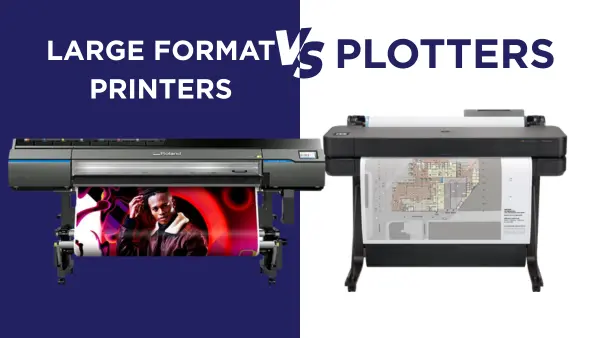
Modern plotters don’t use the pens anymore, and are almost always inkjet-based, which means they’re mechanically similar to what we now call large format printers. A modern plotter is a type of a large format printer, but not all large format printers are plotters. Don’t worry, we’ll break it down for you:
What Large Format Printers Excel At
Large format printers – also called wide format printers – are built for high-quality, full-color output on different types of media. If your output involves images, gradients, photography, marketing materials, or anything where visual impact matters, a large format printer is going to be the right choice.
Common applications include:
- Trade show banners and event signage
- Retail point-of-sale displays and window graphics
- Architectural renderings and presentation boards
- Fine art reproduction and photography prints
- Education and instructional posters
- Vehicle wraps and outdoor advertising
Large format printers handle raster images (a digital graphic composed of pixels) well, making them the preferred choice for print shops, marketing departments, schools, and any organization that regularly produces large-scale visual content.
What Plotters Excel At
Like in the late 50s, plotters were built for precision. The strength of a plotter is producing clean, accurate line work at large scales. Think building plans, blueprints – the kind of technical drawings and documentation that architects, engineers, and designers depend on being accurate and reliable.
If your output is a vector-based technical drawing where dimensional accuracy is a must-have, a plotter will give you tight line quality and more consistent results on drafting and printing materials like vellum, bond, or mylar.
Common applications include:
- Architectural blueprints and construction documents
- Engineering schematics and CAD output
- GIS mapping and survey drawings
- Product design and manufacturing plans
- Structural and mechanical drawings
- Landscape architecture and site plans
Plotters can also be more economical for high-volume line drawing output, since they’re optimized for fine line drawing and use ink more efficiently on technical content.
The Real-World Overlap of Plotters and Large Format Printers:
Many modern large format printers and plotters can do both. Leading manufacturers now produce large format printers that can handle tehcnical drawings with high accuracy in addition to excellent color output. Some firms produce both construction documentation and client-facing presentations – a common feat in architecture and engineering – so a hybrid device that can efficiently handle both makes sense both financially and operationally rather than owning two separate machines.
The tradeoff? A true, dedicated plotter will still outperform the hybrid on pure technical output volume and per-page cost. If you’re printing hundreds of blueprints a week, that efficiency gap matters.
Key Questions to Guide Your Decision
Before deciding between a large format printer or a plotter, it helps to answer a few questions:
-
- What is the majority of your output?
If most of what you print is full-color image-heavy content, you’re in large format printer territory. If it’s predominately line drawings and technical documents, a plotter might be the better fit for your business.
-
- What are your volume requirements?
High-volume technical drawing environments benefit from plotters optimized for volume. Lower volume or mixed-use environments can often get better value from a versatile large format printer.
-
- What media do you print on?
If you regularly print on special technical media – like vellum, mylar, or heavy bond – make sure the device you choose is rated for those materials. Not all large format printers can handle those types of drafting materials.
-
- Do you need both capabilities?
If your team needs to print technical drawings and color presenations, a modern hybrid device – or a managed print solution with the right equipment mix – may elimiate the need to choose between the two at all.
Buy, Lease, or Rent?
Once you’ve identified if you need a large format printer or a plotter, the next decision is how to acquire it. For most businesses, leasing a large format printer or plotter offers significant advantages over outright purchase: predictable monthly costs, easier upgrades as technology evolves, service agreements built in, and not dropping a large lump sum payment to get started printing.
Not Sure? Let’s Figure It Out Together
The right choice depends on your specific needs, volume, and budget – and there’s never a one size fits all solution. Our team at Elevated Group has worked with architects, engineers, schools, print shops, and businesses across a wide range of industries to match them with equipment that fits the way they work.
Whether you need a dedicated plotter, a full-color large format printer, or something in between, we offer sales, leasing, and support to make sure you’re set up for the long term with a great head start.
Get in touch with us for a free consultation. We’ll ask the right questions, walk you through options, and help you make a decision you’re confident in.